


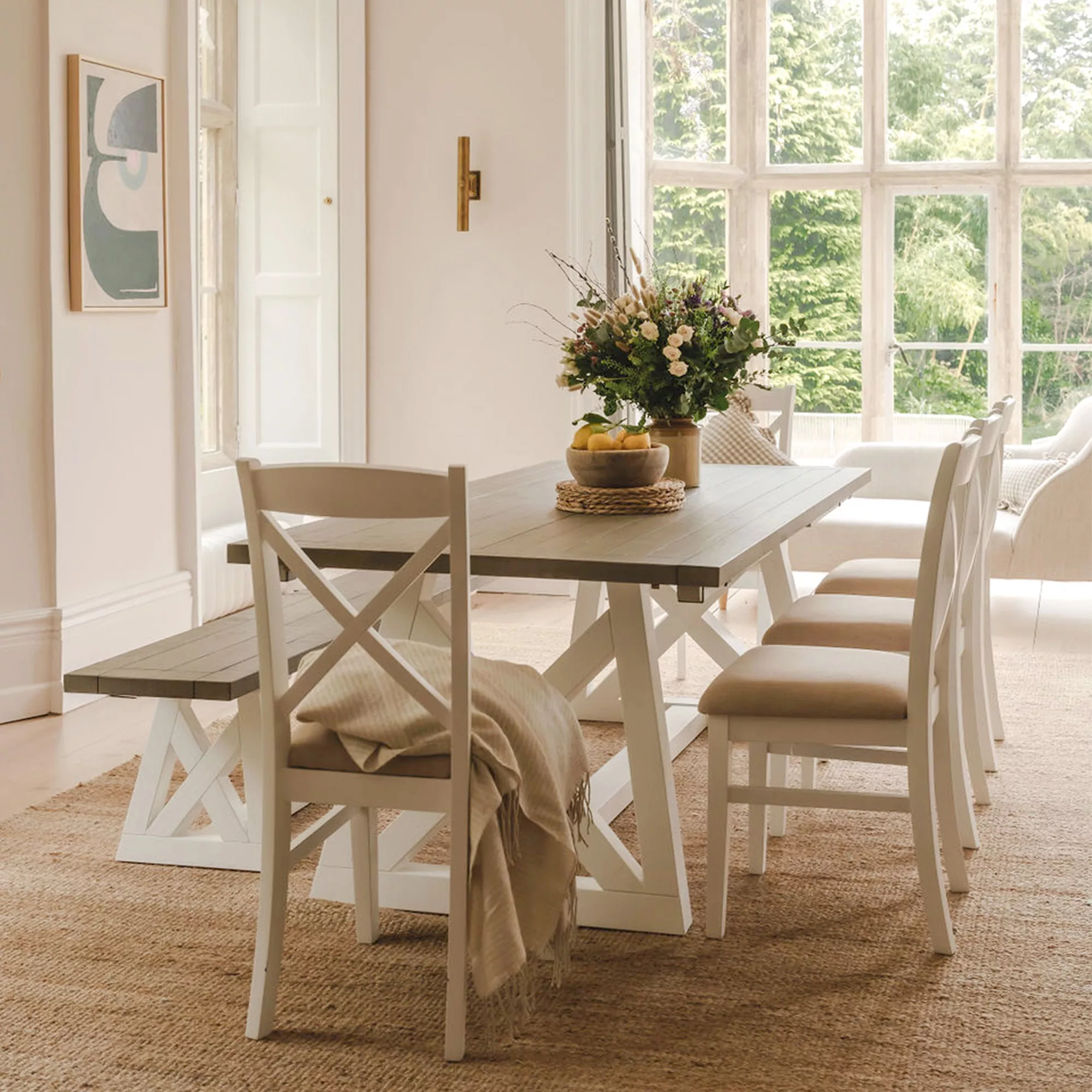
Extendable dining tables are ideal when you want a table that suits everyday meals but can adapt for guests, family occasions or flexible open-plan living. The best mechanism depends on how much space you have, how often you extend the table, where the extra surface stores, and how visible you’re happy for the joins to be.
Below, we compare four common options: drop leaf, centre-leaf, end-extension and flip-top extending tables, including storage needs, seam visibility and the rooms each one suits best.
Quick comparison: drop leaf, centre-leaf, end-extension and flip-top tables
Compare extendable dining table mechanisms by space suitability, storage needs, seam visibility and practical considerations.
Why the extension mechanism matters
An extending table is not just about adding extra seats. The mechanism affects how the table looks, how easy it is to use, how much clearance you need around it, and whether you need somewhere to store a separate leaf.
As a rule, allow at least 90cm (35in) between the table edge and a wall, sideboard or kitchen island so chairs can pull out comfortably. If the table extends into a walkway, aim for 100–120cm (39–47in) where possible, especially in busy family kitchens.
Before choosing, check:
- Closed size: the table size you’ll live with every day.
- Extended size: the size needed when guests come over.
- Leaf storage: whether the extra surface is built in or separate.
- Seam visibility: where the joins appear on the tabletop.
- Ease of use: whether one person can extend it comfortably.
For more sizing help, see our dining table size guide.
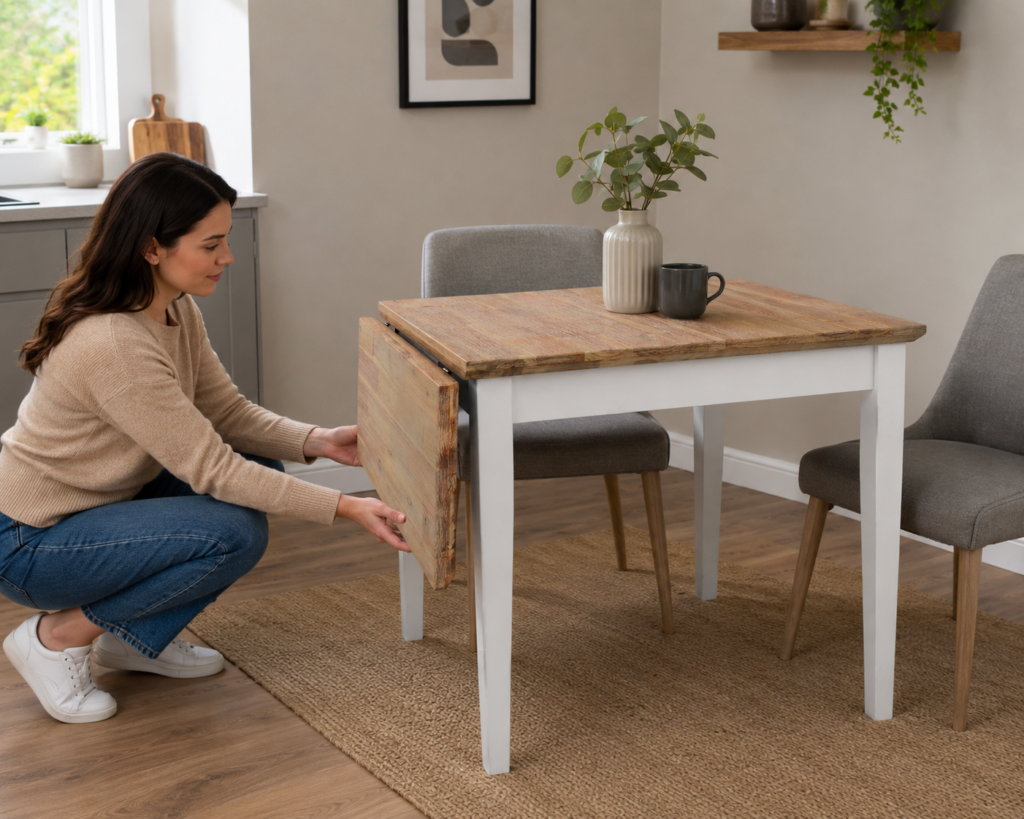
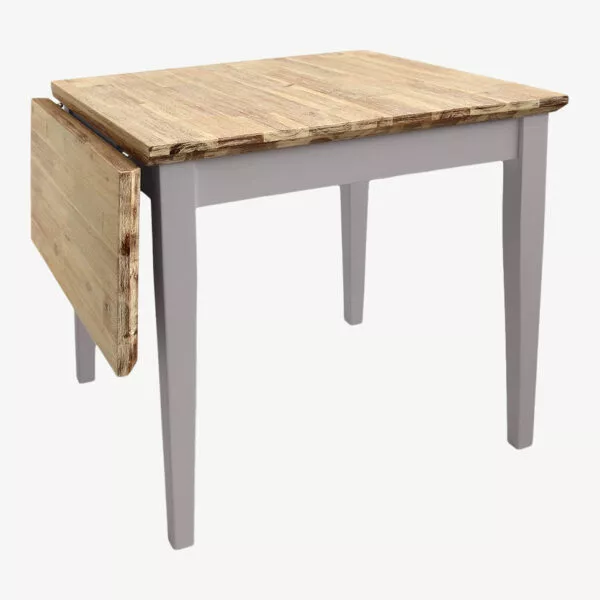
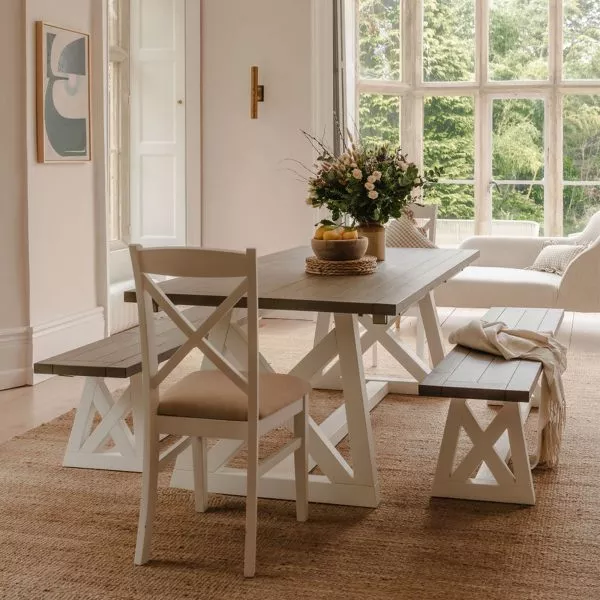
Florence Square Dining Table in White
Drop leaf dining tables
A drop leaf dining table has one or two hinged side sections that fold down when not in use. When you need more surface space, the leaves lift up and are usually supported by swing-out brackets, gate legs or internal supports.
Pros
- Excellent for small spaces: ideal for compact kitchens, flats and multipurpose rooms.
- Can sit against a wall: use one leaf up for two people, or both leaves up for extra guests.
- No separate storage needed: the extension leaves are attached to the table.
- Quick to adjust: practical for breakfast spaces, occasional dining or work-from-home setups.
Cons
- More casual appearance: drop leaf tables often feel less formal than centre-extension designs.
- Hinges are visible: the tabletop will usually show fold lines at the sides.
- Support design matters: gate legs and brackets can affect legroom.
- Usually smaller overall: best for compact dining rather than large dinner parties.
Best space fit
Drop leaf tables are a strong choice if your room needs to change function throughout the day. They work well in kitchen corners, studio flats, bay windows and narrow rooms where a full-size table would feel too permanent.
A common everyday setup is to keep the table at around 70–90cm (28–35in) wide with one leaf down, then open it to 120–160cm (47–63in) when needed. Always check the width with leaves fully raised, especially if the table sits near a wall or doorway.
Shop Florence Square Drop Leaf Dining Tables



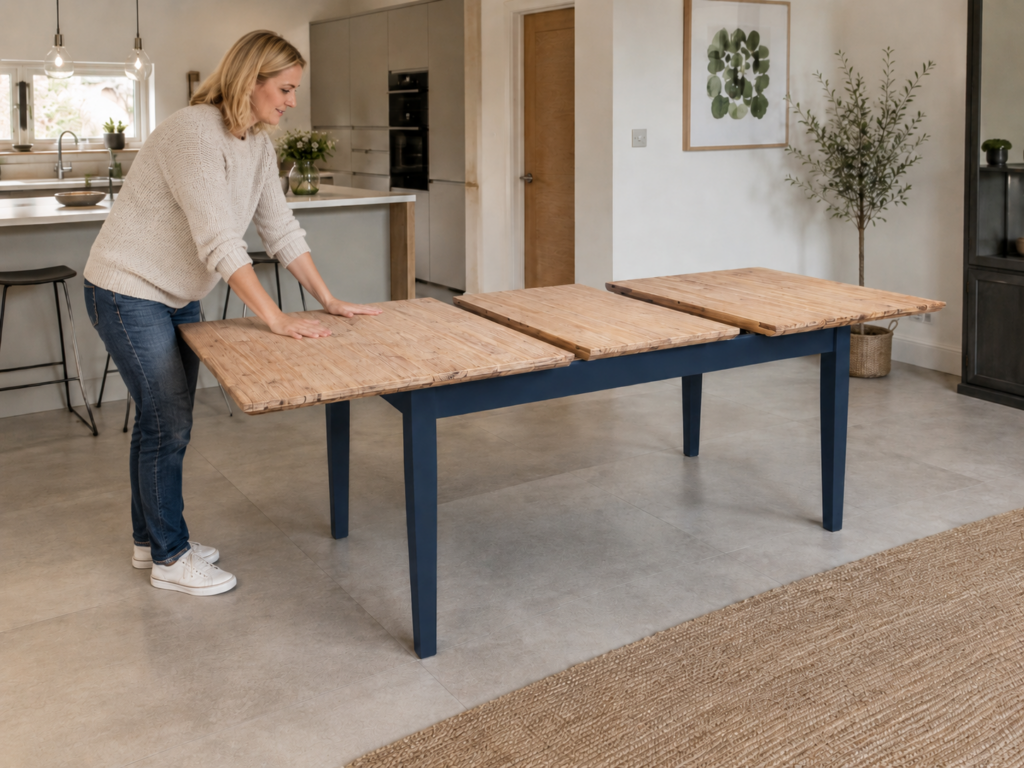
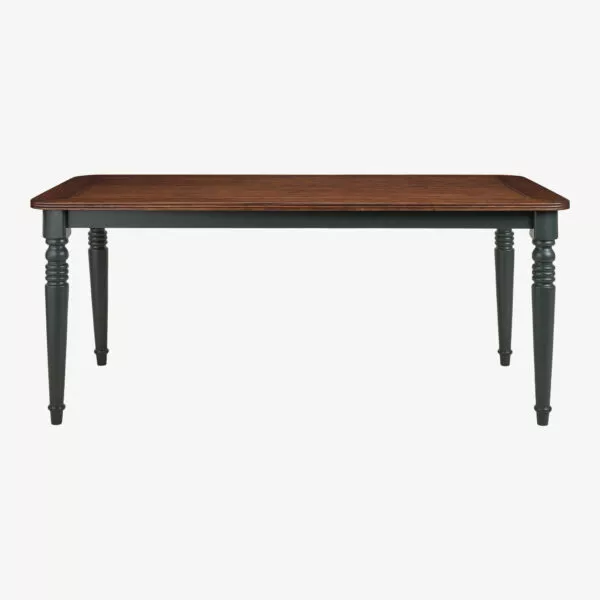
Florence Navy Blue Extendable Rectangle Table
Centre-leaf dining tables
A centre-leaf dining table extends from the middle. You pull the two halves apart, place one or more leaves into the centre gap, then close the tabletop around them.
Pros
- Classic, balanced look: the table extends evenly from the centre.
- Good seating symmetry: diners sit naturally around all sides.
- Flexible hosting: some designs allow one or two leaves depending on the occasion.
- Works well in formal dining spaces: ideal for traditional layouts and larger rooms.
Cons
- Separate storage may be needed: check whether the extension leaf stores inside the table.
- More handling: loose leaves can be awkward for one person.
- Central seams are visible: especially on smooth, pale or high-contrast tabletops.
Best space fit
Centre-leaf tables suit dining rooms where the table sits centrally and has enough space around all sides. They are ideal when you want an everyday table that can grow for Sunday lunch, Christmas dinner or family gatherings.
If the extension leaf is separate, store it flat where it won’t warp or get scratched. A spare-room wardrobe, protected utility cupboard or under-bed storage bag can work well.
For classic dining styles, browse the Florence collection or explore statement traditional pieces in the Queensbury living and dining range.
Discover Florence extendable dining tables
Bring classic dining style and everyday flexibility together with Florence extendable tables — perfect for family meals, relaxed hosting and creating a timeless focal point in your dining space.
End-extension dining tables
An end-extension table adds extra length at one or both ends rather than opening from the centre. Depending on the design, the extension may pull out, slide out or use a removable end leaf.
Pros
- Keeps the centre setting intact: useful if you have already laid the table.
- Good for narrow rooms: the table grows lengthways rather than feeling wider.
- Works well with benches: especially where one side of the table sits close to a wall.
- Less disruption: you may only need to move chairs at the ends.
Cons
- End legroom can vary: check where supports, legs or runners sit when extended.
- Seams appear near the ends: usually less central, but still visible.
- Storage varies by model: some designs have built-in leaves, others need separate storage.
Best space fit
End-extension tables are useful in long kitchens, open-plan dining spaces and rooms where the table naturally sits lengthways. They are also practical if you like to keep serving dishes, placemats or a centrepiece in the middle while adding extra seats at the ends.
For modern dining rooms, explore the Oxford extendable dining tables. For cleaner Scandi-inspired proportions, the Edvard Olsen range is a good place to start.
Explore Oxford extendable dining tables
Create a modern dining space that adapts with ease — Oxford extendable tables offer clean styling, practical proportions and extra room when guests gather.
Flip-top extending dining tables
A flip-top extending dining table has a tabletop that folds in half. To extend it, the top usually slides or rotates on a rail, opens out, then recentres so the larger surface sits evenly over the base. You may also see this described as a fold-over, folding top or flip-top rail extension table.
Pros
- Built-in extension: there is no loose leaf to store separately.
- Fast to open: often easier than lifting and aligning a separate centre leaf.
- Compact when closed: useful where everyday space is limited.
- Recentred top: the rail system helps the extended surface sit properly over the base.
- Neat for occasional hosting: good for homes that need flexibility without a large table all week.
Cons
- Visible fold line: the table will usually have a central seam when opened.
- Heavier tabletop: the folding top can need two hands to operate smoothly.
- Mechanism quality matters: check that the rails feel stable and lock securely.
- Base position is important: make sure legroom still works once the top is extended.
Best space fit
Flip-top tables are especially useful in compact dining areas, apartments and open-plan rooms where the table is used at a smaller size most of the time. Because the extension is built into the top, they are also helpful if you do not have space to store separate leaves.
When measuring, check the table in both positions. A closed table of 90cm (35in) can become 180cm (71in) once flipped open, so you still need to plan for the full extended footprint.
How much space do you need for an extendable dining table?
Measure for the table at its largest size, not just the size you’ll use day to day.
Minimum clearances to check
If space is tight, benches can help because they tuck further under the table than chairs. Our guide to dining benches vs chairs can help you decide which seating style suits your room.
Shop dining benches for flexible seating
Make the most of a compact dining space with benches that tuck neatly under the table, create room for extra guests and pair beautifully with both fixed and extendable dining tables.
Which mechanism hides seams best?
No extending table is completely seam-free, but some mechanisms make joins less noticeable than others.
Lowest seam impact
End-extension tables often keep the main central surface uninterrupted, with joins closer to the ends. This can be useful if you prefer a cleaner tabletop day to day.
Most visible seams
Drop leaf and flip-top tables usually have clear fold lines because the surface physically hinges or folds. Centre-leaf tables also show central seams, especially where the removable leaf meets the main tabletop.
Practical tip
If seam visibility matters, choose a tabletop with natural grain, plank detail or a slightly rustic finish. These surfaces are more forgiving than very plain, smooth or pale finishes.
Which extending table is easiest to store?
The easiest option is any table with a built-in extension. Drop leaf, end-extension and flip-top tables often keep everything attached to the table, so there is nothing separate to carry, protect or misplace.
Centre-leaf tables may need separate leaf storage, although some designs include internal storage. If your table uses loose leaves, keep them:
- flat rather than leaning at an angle;
- away from radiators or damp walls;
- wrapped in a soft cover or blanket;
- close enough that you’ll actually use them.
A dining table leaf stored in the loft might be safe, but it is not very convenient before a dinner party.
Ready to find an extendable table that suits your space, routine and hosting style? Browse our dining ranges, including Florence, Queensbury, Edvard Olsen and Oxford, or book a quick sizing and selection chat for help choosing the right mechanism, finish and fit.





%20–%20Navy%20Blue&url=https://furniture.co.uk/product/florence-large-pedestal-round-dining-table-120cm-navy-blue/&media=https://furniture.co.uk/wp-content/uploads/2023/05/Florence-Pedestal-Table-in-Navy-Blue-1024x1024.jpg)


FAQs
What is the best type of extendable dining table?
The best type depends on your space. Drop leaf tables are best for compact rooms, centre-leaf tables suit classic dining rooms, end-extension tables work well in narrow spaces, and flip-top tables are useful when you want a built-in extension without separate storage.
Are drop leaf dining tables good for small spaces?
Yes. Drop leaf dining tables are one of the best options for small spaces because one or both sides can fold down when not in use. They work particularly well against a wall or in a compact kitchen.
What is a flip-top extending dining table?
A flip-top extending dining table has a tabletop that folds in half. The top usually moves on a rail, opens out, and recentres over the base to create a larger dining surface.
Which extending table has the least visible seams?
End-extension tables often have less noticeable seams because the joins sit nearer the ends rather than across the centre. Natural wood grain and rustic finishes can also help seams blend in.
Do centre-leaf dining tables need separate storage?
Some centre-leaf dining tables have built-in leaf storage, but many use separate leaves. Always check the product details before buying and make sure you have somewhere flat and dry to store loose leaves.
How much space do you need around an extendable dining table?
Allow at least 90cm (35in) from the table edge to walls or furniture for comfortable chair movement. For busy walkways, aim for 100–120cm (39–47in) where possible.
Shop all dining tables
Find the right table for everyday meals, weekend hosting and everything in between — explore our full range of dining tables in classic, modern and space-saving styles.

Share this:


